Heading through the famous King’s square, popularly known as the ring road in the city of Benin, Nigeria. Surrounding it is the Benin National Museum, which houses some of the finest arts and crafts of the Bini people and also serves as a tourist attraction for visitors wishing to know more about the ancient great Benin kingdom.
This is where the infamous Benin Massacre occurred in 1897, leading to the fall of the Benin Empire. Most of the great and marvellous crafts were looted as trophies by British soldiers, including the Queen Idia head. Most of these crafts and artefacts were sold to other countries, while some are kept in the British National Museum (although efforts are underway to secure their return).
As the story unfolds, it tells of a great and powerful Benin king known as Oba Ovoramwen Nogbaisi, the ruler of the great Benin kingdom and one of the most powerful and prosperous kingdoms in the West Africa region.
Back then, the Benin kingdom regularly traded slaves, ivory, pepper and palm oil with the Portuguese as early as 1485. At the height of their power, in 1853 the British made contact with the Bini (Benin people) to trade pepper, palm oil, clothing, and ivory.
Fakta om Benin-massakeren

Due to its economic and military power, Benin independently ran its trading activities in its region and was not subjected to the orders of any other kingdom or empire, not even Britain.
After a series of successful trades, a British vice-consul, Henry Galway, visited Benin with the intention of annexing the kingdom through a treaty. He presented this so-called treaty of “commerce and friendship” to the Oba, who were sceptical about it and about Britain. The Oba however signed the treaty, agreeing to stop slavery and human sacrifice in Benin, which was a common practice then. Later, Oba Ovoramwen realised that the treaty was simply a tactic to annex Benin into the British Empire, and he forbade his people to trade with the British and prevented them from entering Benin.
This and a series of events caused the British merchants around the region to rage over Oba Ovoramwen’s decision. His actions seemed fatal to their trading business and a violation of the signed peace treaty, and they subsequently convinced British authorities to overthrow the Oba and annex his kingdom.
In November 1896, acting Consul General James Robert Philips went to Benin with his “friendly troops,” which consisted of two commercial agents, two Niger Coast Protectorate officers, a medical officer and 250 African soldiers disguised as porters. He sent a letter to the Oba stating that he was coming on a “friendly visit” to discuss trade and peace, all while waiting for permission from British authorities to invade Benin.
Unfortunately for Phillips, he arrived during the ongoing Igue festival. The Igue festival was originally celebrated as a ritual to renew the Oba’s magical powers, and during the Igue ritual season, the Oba is forbidden to be in the presence of any non-indigenous persons. Despite being warned by a small faction of the Benin army about the ongoing festival and its consequences, Philips turned a deaf ear and went ahead with his visit.
Unfortunately, he was killed along with his troops. Only two Britons survived the attack. This is what today is referred to as the start of the Benin Massacre of 1897.
Upon hearing this, the British government retaliated by sending well armed troops, consisting mainly of Africans, to attack and destroy the Benin Empire.
The bombardment of Benin began on 9 February 1897. Although the Benin forces attempted to repel the attack in commando style, their weapons, which mainly consisted of machetes, spears and arrows, were no match for the British rifles and cannons. Every house in the kingdom was overtaken and the people were killed regardless of gender, age or status. Notably, the African soldiers within the British troops did most of the fighting, while the British soldiers operated machine guns and cannons from the rear.
Shortly after ravaging the kingdom, Oba Ovoramwen was captured by British Consul General Ralph Moor and brought before British law.
Oba Ovoramwen Nogbaisi was put on trial and found guilty. He was deposed and, along with two of his wives, exiled to Calabar, where he died in January 1914. After Benin was laid to waste, British troops plundered the kingdom and transported its precious artefacts and works of art. The loot was auctioned off to cover the costs of the expedition.
However, most of these arts and artefacts still reside in foreign museums. This contributed to the fall of the great Benin Empire.
In any case, most people today do not know how this city came to be. Benin City is now largely a commercial hub. And so there it is: the great Benin Empire, once one of the most powerful and richest kingdoms in West Africa.
Everything comes to an end.
Related Posts
 The last stand of the Kingdom of Benin: art theft and royal exile
The mighty Oba's bronze treasures now gather dust in London museums, stolen spoils of Britain's…
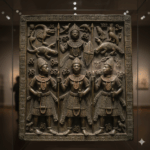 The Benin bronzes: art, theft, and restitution
A Legacy Cast in FireIn the heart of present-day Edo State, Nigeria, the royal palace…
 Beyond Wakanda: the real kingdoms that inspired the hype
A history meets pop culture look at Mali, Benin, and Lesotho's regal legacies When Black…