It shimmers like a mirage at the edge of the world, a vast wind-scoured expanse of alkaline water stretching 290 kilometres through the volcanic badlands of northern Kenya. Lake Turkana, known as the Jade Sea for its striking blue-green colour, is one of the most remote and extraordinary places on Earth. It is also, by many measures, the cradle of our species.
Few destinations on the African continent demand as much from a traveller, and offer as much in return. To reach Turkana is to journey back in time, not just through the geological record beneath your feet, but through something more personal and more unsettling: the deep history of what it means to be human.
A Sea Born from Fire
Lake Turkana sits within the East African Rift System, one of the most geologically active regions on the planet, where the African continent is slowly tearing itself apart along ancient fault lines. The lake formed around 4 million years ago, fed by rivers flowing from the Ethiopian Highlands to the north. Today it is the world’s largest permanent desert lake, and the world’s largest alkaline lake, a vast windswept body of water covering nearly 6,500 square kilometres, with no outlet to the sea.
The landscape surrounding it is stark and elemental. Extinct volcanoes rise from the shoreline. Lava fields stretch to the horizon. South Island, one of three volcanic islands in the lake, still emits occasional plumes of gas. The water itself glows with a shifting palette of greens and blues, coloured by the vast blooms of algae and cyanobacteria that thrive in its mineral-rich waters. It is beautiful in the way that only wilderness can be, indifferent to human comfort, but impossible to look away from.
Where Our Ancestors Walked
But it is what lies beneath the surrounding sediments that has made Turkana famous far beyond the world of travellers and adventure seekers. The shores of this ancient lake have yielded some of the most significant fossil discoveries in the history of paleoanthropology, physical evidence of the long, branching story of human evolution stretching back millions of years.
It was here, on the eastern shore of the lake in 1984, that the renowned paleoanthropologist Richard Leakey and his team unearthed the Turkana Boy, the most complete skeleton of an early human ancestor ever found. The boy, identified as Homo ergaster (or early Homo erectus), lived approximately 1.6 million years ago. He was around eight to twelve years old when he died, already nearly 160 centimetres tall, with a body built for long-distance walking across open savanna. His discovery reshaped our understanding of human prehistory.
The Turkana Basin has since produced fossils from more than twenty hominin species, including Australopithecus anamensis, one of the earliest known ancestors of the human lineage, dating back more than four million years. The region has also yielded stone tools from the Oldowan and Acheulean traditions, among the oldest evidence of human technology anywhere on Earth. UNESCO recognised the area’s extraordinary significance in 1997, designating the Lake Turkana National Parks a World Heritage Site.
The People of the Jade Sea
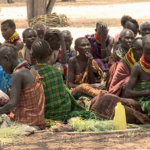
Long before scientists arrived with brushes and measuring equipment, people were living along the shores of Turkana. Today the lake is surrounded by several distinct ethnic groups, among them the Turkana, El Molo, Daasanach, and Samburu, each with their own language, traditions, and relationship to the water and the land.
The El Molo, one of the smallest ethnic communities in Kenya, have fished the lake for centuries using traditional rafts made from doum palm logs. Their population once dwindled to a few hundred individuals, though numbers have grown in recent decades. The Turkana people, nomadic pastoralists who give the lake its name, herd camels and goats across the surrounding semi-arid plains, reading the land with knowledge accumulated across generations.
Visiting these communities offers a dimension to Turkana that no fossil site can provide: a living, breathing connection to a landscape that has sustained human life in one form or another for millions of years. The continuity is humbling. These shores have never been empty.
Getting There and Why the Journey Matters
Reaching Lake Turkana is not a casual undertaking. The most common overland route runs north from Nairobi through Maralal and Loyangalani, a journey of roughly 750 kilometres that crosses some of Kenya’s most challenging terrain. Roads can disappear in the rains. Distances between fuel stops are unforgiving. Most visitors travel in four-wheel-drive vehicles, ideally with a local guide who knows the road and the communities along the way.
There are also light aircraft connections to Loyangalani, the main settlement on the eastern shore, for those with less time. The overland route, though, offers encounters that no flight can replicate: the gradual shift in vegetation from highland forest to scrubland to desert, the moment when the lake first appears on the horizon like something conjured from heat and light.
Accommodation options range from basic campsites to the comfortable Oasis Lodge near Loyangalani. The best time to visit is October to February, when temperatures are slightly more forgiving and the notorious Turkana winds, which can reach gale force in the afternoons, are at their least fierce. Those winds, incidentally, are the reason the lake has become one of the best kitesurfing destinations in Africa, drawing a small but growing community of adventurers from around the world.
A Place Under Pressure
For all its remoteness, Lake Turkana is not insulated from the pressures of the modern world. The lake’s water levels have been falling for decades, largely due to the construction of the Gibe III dam on the Omo River in Ethiopia, which provides the majority of the lake’s inflow. Researchers have warned that reduced water flow is threatening fish stocks, destabilising livelihoods, and increasing tensions between communities competing for shrinking resources.
Climate change adds another layer of uncertainty. Rainfall patterns across the region are becoming less predictable. Pastoralist communities face more frequent droughts. The fragile ecosystem that has sustained life here for millions of years is under stress in ways that no previous era has witnessed at this speed.
There is a deep irony in visiting a place that witnessed the birth of our species and finding that what threatens it most is the civilisation that species eventually built. But that tension is also part of what makes Turkana essential to understand, not just as a destination, but as a mirror.
Standing at the Beginning
On the shore of the Jade Sea, as the wind comes up in the late afternoon and the water changes colour from green to silver to something almost black, it is possible to feel the weight of deep time in a way that few places on Earth allow. The bones beneath your feet are older than memory, older than language, older than fire. And yet they are your bones in a very real sense, the record of a journey that eventually led, through ten thousand generations of wandering, to this moment.
Lake Turkana is not an easy place to reach, and it will not comfort you with luxury. But it will give you something rarer: a sense of proportion, and a glimpse of the long arc of life on this extraordinary continent.