The Swahili Coast history: a civilisation built on the sea
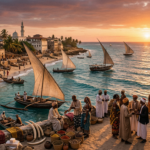
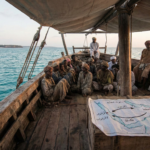
For more than a thousand years, the eastern coast of Africa hummed with the activity of one of the world’s most remarkable trading civilisations. The Swahili Coast history is a story of monsoon winds, merchant dhows, coral stone cities, and a culture that grew where Africa met Arabia and Asia. It is a history that belongs firmly to Africa, yet it connects that continent to the wider world in ways few other regions can match.
Stretching roughly from modern-day Somalia in the north to Mozambique in the south, and including the islands of Zanzibar, Pemba, and the Comoros, the Swahili Coast was never a single empire or nation. Instead, it was a network of city-states, each one a hub of commerce, scholarship, and cultural exchange. Towns such as Kilwa, Mombasa, Malindi, Lamu, and Sofala rose to prominence over the centuries, each with its own ruling elite and its own connections to the broader Indian Ocean world.
Origins and early settlement
The Swahili people descend primarily from Bantu-speaking communities who migrated to the East African coast from the interior over two thousand years ago. These early settlers were farmers and fishermen who gradually established villages along the shoreline. By the first century CE, Greek and Roman texts were already describing a string of trading ports along what they called the “Azania” coast. The Periplus of the Erythraean Sea, a Greek merchant guide from around 50 CE, mentions towns where ivory, tortoiseshell, and iron were exchanged for cloth and glassware from the Mediterranean world.
Trade with the Arabian Peninsula and the Persian Gulf expanded significantly from around the seventh century onwards. The arrival of Islam along the coast transformed Swahili society. Merchants from Oman, Yemen, and Persia settled in coastal towns and intermarried with local families. In time, a new, distinct culture emerged: neither purely African nor purely Arab, but something original and enduring. The Swahili language itself reflects this synthesis, with a Bantu grammatical core enriched by Arabic vocabulary.
The golden age of Kilwa
Between the tenth and fifteenth centuries, the Swahili city-states reached their peak. Kilwa Kisiwani, a small island off the southern coast of present-day Tanzania, became one of the wealthiest cities in the known world. The great Moroccan traveller Ibn Battuta visited Kilwa in 1331 and described it as one of the most beautiful cities on earth. He noted its sultan’s generosity, the quality of its buildings, and the sophistication of its court.
Kilwa’s wealth rested largely on control of the gold trade from the interior of southern Africa. Gold from the Zimbabwe Plateau passed through Kilwa on its way to India, Persia, and China. Chinese porcelain, Indian cotton, and Persian ceramics flowed back in return. Today, fragments of these goods still surface in archaeological digs along the coast and in the ruins of Great Zimbabwe, offering tangible proof of a trade network that spanned the Indian Ocean.
The architecture of this era still impresses. The Great Mosque of Kilwa, built largely in the twelfth century and expanded over several hundred years, is one of the oldest mosques in sub-Saharan Africa. The palace complex of Husuni Kubwa, constructed in the early fourteenth century, featured dozens of rooms, a swimming pool, and an octagonal bathing pool. These were not the constructions of a peripheral society. They were the achievements of a confident, prosperous civilisation.
The arrival of the Portuguese
The arrival of Vasco da Gama on the East African coast in 1498 marked a turning point in Swahili Coast history. The Portuguese sought to seize control of the Indian Ocean trade routes that had made the city-states so prosperous. They attacked, looted, and in some cases destroyed towns that refused to submit. Kilwa was sacked in 1505. Mombasa suffered repeated assaults over the following decades.
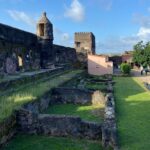
Portuguese dominance, however, was never total. The city-states resisted, and some recovered. Furthermore, the Omani Arabs emerged as powerful rivals to Portugal during the seventeenth century. By 1698, the Omani sultanate had driven the Portuguese from Fort Jesus in Mombasa after a prolonged siege. Oman gradually extended its influence over much of the Swahili Coast, culminating in the establishment of the Sultanate of Zanzibar in the nineteenth century under Seyyid Said.
The Omani period brought renewed prosperity in some respects, but also intensified the trade in enslaved people. Zanzibar became the largest slave market in the Indian Ocean world. By the mid-nineteenth century, tens of thousands of enslaved Africans passed through Zanzibar each year. This chapter of the coast’s history remains painful and is central to understanding the region’s deeper social and cultural wounds.
Legacy and living culture
The Swahili Coast today carries its history in its architecture, language, food, and art. Lamu Old Town in Kenya and Stone Town in Zanzibar are both UNESCO World Heritage Sites. Their narrow streets, intricately carved wooden doors, and coral stone buildings speak directly to centuries of Indian Ocean exchange. In these towns, the past is not a museum exhibit. It is the lived environment of daily life.
The Swahili language, meanwhile, has grown from a coastal trade lingua franca into one of Africa’s most widely spoken languages, used by over 200 million people across East and Central Africa. It carries within its words the full weight of the coast’s complex history: African, Arab, Persian, Indian, and Portuguese influences woven together into a single, living tongue.
In recent years, historians and archaeologists have worked to reclaim and reframe the Swahili Coast story on its own terms. For too long, outside narratives placed Arab or Asian merchants at the centre of the coast’s achievements, overlooking the creativity and agency of the African communities who built these cities. Contemporary scholarship increasingly recognises the Swahili civilisation as a fundamentally African achievement, one that engaged the wider world on its own terms and produced a culture of extraordinary richness. That legacy deserves to be known far beyond the shores where it was born.