Long before European ships rounded the Cape of Good Hope, a sophisticated civilisation had already mastered the Indian Ocean. For more than a thousand years, the Swahili Coast, a stretch of East African shoreline running from southern Somalia down through Kenya, Tanzania, and Mozambique, was one of the world’s great crossroads of commerce, culture, and faith.
The story of the Swahili Coast is a story of trade, and of what happens when the world comes to your shore and you shape it on your own terms.
A Coast Born from the Wind
The Indian Ocean is not a barrier. It is a highway, and for centuries, the monsoon winds were its engine. The northeast monsoon, blowing reliably from November to March, carried Arab, Persian, and later Indian merchants southward along the East African coast. When the winds reversed in April, the same sailors rode the southwest monsoon back home, their wooden dhows loaded with ivory, gold, iron, and enslaved people.
African traders understood these rhythms intimately. Bantu-speaking communities had been farming and fishing along this coast for centuries before the first foreign merchants arrived. As trade intensified from roughly the 8th century CE onward, something remarkable happened: instead of being overwhelmed by outside influence, coastal Africans absorbed, adapted, and created something entirely new.
That creation was Swahili civilisation, and its language, culture, and architecture still define East Africa today.
Cities of Coral and Commerce
At its height, the Swahili Coast was home to dozens of thriving city states, each built from coral stone and ambition. Kilwa Kisiwani, on an island off the southern coast of present-day Tanzania, dazzled visiting Arab geographer Ibn Battuta in 1331. He described it as one of the most beautiful cities in the world, a place of grand mosques, prosperous merchants, and lavish hospitality.
Kilwa was not alone. Mombasa, Malindi, Zanzibar, Pate, Lamu, Mozambique Island: each was a node in a vast network that connected the African interior to the Persian Gulf, the Indian subcontinent, and the ports of China. Chinese celadon pottery has been found in the ruins of Kilwa. Coins minted in Kilwa have been discovered in Zimbabwe. The trade routes ran deep, and they ran far.
Merchants traded in extraordinary volumes of goods. Gold came from the kingdoms of the interior, most famously from Great Zimbabwe, whose stone-walled city controlled access to vast mining regions. Ivory was prized across Asia. Iron, copper, mangrove timber, and enslaved people also passed through Swahili ports. In return, the coast received Persian ceramics, Indian textiles, glass beads, and porcelain from the Song and Ming dynasties of China.
The wealth of these cities was real, and it was African-made. The Swahili were not passive recipients of foreign largesse. They were active brokers who controlled access to the interior and set the terms of trade on their own coastline.
A Culture Woven from Many Threads
Swahili culture defies easy categorisation, which is precisely what makes it so fascinating. The word “Swahili” itself derives from the Arabic sawahil, meaning “coasts,” a name that captures both geography and identity. The people of this coast were African in origin, but their civilisation incorporated strands from Arabia, Persia, India, and beyond.
Islam arrived on the Swahili Coast early, possibly as early as the 8th or 9th century, and became deeply embedded in coastal identity. Mosques were built in coral stone, their architecture blending African construction traditions with Islamic design. Friday prayers, Ramadan, and the call to prayer became pillars of daily life. Yet Swahili Islam was never identical to Islam elsewhere. It developed its own local character, blended with ancestral practices and coastal traditions.
The Swahili language itself tells the story of this synthesis. Its grammatical structure and core vocabulary are unmistakably Bantu, rooted in the same African linguistic family as Zulu, Kikuyu, and Lingala. But it absorbed hundreds of loanwords from Arabic, Persian, Portuguese, and later English and Hindi. Today, Swahili is spoken by over 200 million people across East and Central Africa, serving as a lingua franca for the entire region. Its origins lie in this ancient coastal exchange.
Architecture was another expression of Swahili creativity. The great coral stone houses of Lamu, still standing today, feature elaborately carved wooden doors, inner courtyards designed to catch the sea breeze, and layered ornamentation that reflects centuries of artistic dialogue between Africa and the wider Indian Ocean world. They are unlike anything else on the continent, and yet they are unmistakably African.
The Coming of the Portuguese and the Fractures of Empire
The arrival of Portuguese ships at the end of the 15th century marked a violent rupture in the Swahili world. Vasco da Gama rounded the Cape in 1497 and sailed up the East African coast, arriving at Malindi and Mombasa. The Portuguese did not come to trade as equals. They came to seize control of the Indian Ocean trade routes that Arab and Swahili merchants had dominated for centuries.
What followed was brutal. Portuguese cannons bombarded Kilwa and Mombasa. Fort Jesus, the massive stone fortress that still watches over Mombasa harbour today, was built by the Portuguese in 1593 as a symbol of domination. The Swahili city states resisted, forged alliances with the Omani Sultanate, and eventually drove the Portuguese back in the late 17th century, only to find themselves increasingly under the influence of Oman instead.
By the 19th century, the Sultanate of Zanzibar, nominally Omani but deeply Swahili in character, had become the dominant power on the coast and, tragically, a central hub of the East African slave trade. Tens of thousands of people were shipped from the interior to Zanzibar’s notorious slave market each year, destined for plantations across the Indian Ocean world. The trade left wounds that have never fully healed.
A Legacy That Endures
The Swahili Coast today is a place of ruins, revival, and living culture. Lamu Old Town, a UNESCO World Heritage Site, still looks much as it did five hundred years ago, its narrow streets, coral buildings, and hand-carved doors a tangible link to a prosperous past. The ruins of Kilwa Kisiwani, also a UNESCO site, rise dramatically from the island vegetation, their scale hinting at a grandeur that once rivalled any city on the medieval world stage.
But the Swahili Coast’s most important legacy is not in stone. It is in language, in cuisine, in music, in the easy cosmopolitanism that still characterises the towns and cities of the East African shoreline. It is in the way a Swahili fisherman in Zanzibar or a merchant in Mombasa carries, perhaps without knowing it, the accumulated weight of a thousand years of exchange.
The trade winds still blow. The dhows still sail. And the coast still faces the sea, open as it has always been to the world beyond the horizon.
Related Posts
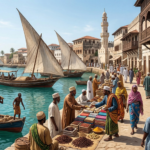 The Swahili Coast: a history of trade and culture
The Swahili Coast history: a civilisation built on the sea For more than a thousand…
 The coastal forts of East Africa: guardians of the Indian Ocean trade
At the edge of Mombasa's Old Town, where the Indian Ocean breeze carries the scent…
 The Indian Ocean slave trade: East Africa to the Middle East's hidden routes
/* Main Layout */ .slave-trade-wrapper { font-family: 'Helvetica Neue', Helvetica, Arial, sans-serif; line-height: 1.6; color:…