Long before European ships appeared on the horizon, the West Africa ancient kingdoms of Ghana, Mali and Songhai stood among the most powerful states on earth. They built cities, controlled trade routes and produced scholars whose work reached across continents. Their story is one of ambition, wealth and enduring influence.
The ancient kingdoms of West Africa and the gold that built them
The Kingdom of Ghana rose to prominence around the sixth century CE. It sat at the crossroads of trans-Saharan trade, where merchants exchanged gold from the south for salt from the north. Ghana’s rulers taxed every load that passed through their territory. As a result, they accumulated extraordinary wealth and political power. The kingdom thrived for several centuries before internal pressures and external raids weakened its grip on the region.
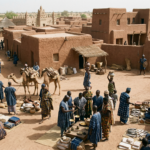
Mali followed, and it surpassed Ghana in both size and ambition. Under Mansa Musa, who ruled in the early fourteenth century, Mali became one of the largest empires in the world. His famous pilgrimage to Mecca in 1324 brought so much gold to Cairo and other cities that it reportedly depressed gold prices across the Mediterranean for years. Moreover, Mansa Musa invested heavily in education and architecture. The city of Timbuktu became a centre of Islamic scholarship, home to thousands of students and a library tradition that scholars still study today.
Songhai and the height of West African power
The Songhai Empire eventually absorbed much of Mali’s territory and expanded further. Under Sunni Ali in the fifteenth century, Songhai became the largest empire in West African history. Its rulers controlled the Niger River trade and maintained a professional army and navy. However, the empire’s complexity also made it vulnerable. In 1591, a Moroccan force crossed the Sahara and defeated Songhai at the Battle of Tondibi. The empire fragmented, though its cultural legacy endured.
These three empires shared a common thread. They all depended on the trans-Saharan trade network, and they all adapted Islam to local traditions in creative and sophisticated ways. Furthermore, they produced administrative systems, legal frameworks and urban centres that rivalled anything in the medieval world.
Why this history still matters
For many outside Africa, West African history begins with the transatlantic slave trade or colonial partition. That framing erases centuries of achievement. In fact, the great empires of the western Sudan shaped the politics and culture of an entire continent long before European contact. Their influence appears in architecture, oral tradition, religious practice and governance across the region today.
Timbuktu alone held an estimated 700,000 manuscripts at its peak, covering mathematics, astronomy, medicine and law. Many of these documents survive and continue to be catalogued by researchers. Therefore, the story of West Africa’s ancient kingdoms is historical, but it is also alive, ongoing and deeply relevant to how the continent understands itself.
Travelling through Mali, Ghana or Nigeria today, you encounter echoes of these empires in names, ceremonies and the quiet pride of communities that know where they come from. That depth of history is, finally, one of the strongest reasons to look beyond the surface when exploring West Africa.